
In Modern History, students investigate the causes and consequences of significant events, movements and individuals that shaped the modern world. The course encourages students to consider different perspectives, analyse historical evidence and make informed judgements about the past. Through these challenges, students develop their research, writing and critical thinking skills, as well as the ability to evaluate information carefully and construct clear historical arguments.
In Year 11, students study the Meiji Restoration, examining how Japan transformed from a feudal society into a modern imperial power. They investigate the collapse of the Romanov dynasty and the revolutionary forces that reshaped Russia in the early twentieth century, before undertaking a personality study of Leon Trotsky and his role in revolution, civil war and political struggle. Students also complete a study of Wars of Conquest, exploring how military expansion, power and resistance have shaped historical change. These units are designed to build students’ understanding of modern history while equipping them with the skills and context needed to move confidently into their HSC year.
Contact
Head of History: Julia Kerr
Email: [email protected]

Year 11
Preliminary Course
The Preliminary Course investigates a series of case studies that introduce students to interesting aspects of the past that have a lasting relevance to the world today such as the Russian Revolution, the Meiji Restoration, and the Age of Imperialism. Students also conduct their own research on an area of modern history of interest to them.
HSC Course
For the HSC course, students start with a study of Power and Authority in the Modern World, a topic which looks at the rise of dictatorships in Europe after World War I with particular focus on Nazi Germany. They consider what factors led to the rise of dictators, and how, once in power, dictators maintained their position and sought to transform the societies they controlled.
Students then will study some of the following options:
- Russia and the Soviet Union 1917-1941
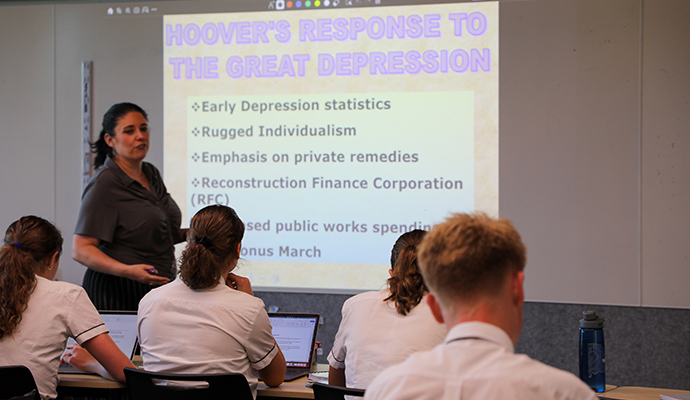
- USA 1919-1941
- Japan 1904-1937
- Conflict in the Pacific
- World War II in Europe
- Civil Rights in the United States between 1945 and 1968
- The end of Apartheid in South Africa 1948-1994
- The Nuclear Age 1945-2021
Assessment
- Written tasks
- Research task
- Trial Examination